
How Old Are Your Tires? Reading the DOT Date Code
Every tire sold in the US has a DOT code on the sidewall ending in four digits: the first two are the week of manufacture and the last two are the year. A code ending in 3224 was made in the 32nd week of 2024, which is early August.
Tire makers set a hard limit of ten years from that date and recommend annual inspection after five, while many automakers say six years. When buying new tires, you have every right to ask how old the stock is, and a reasonable retailer will happily tell you. Here is how to find the code and what to do about tires that are too old.
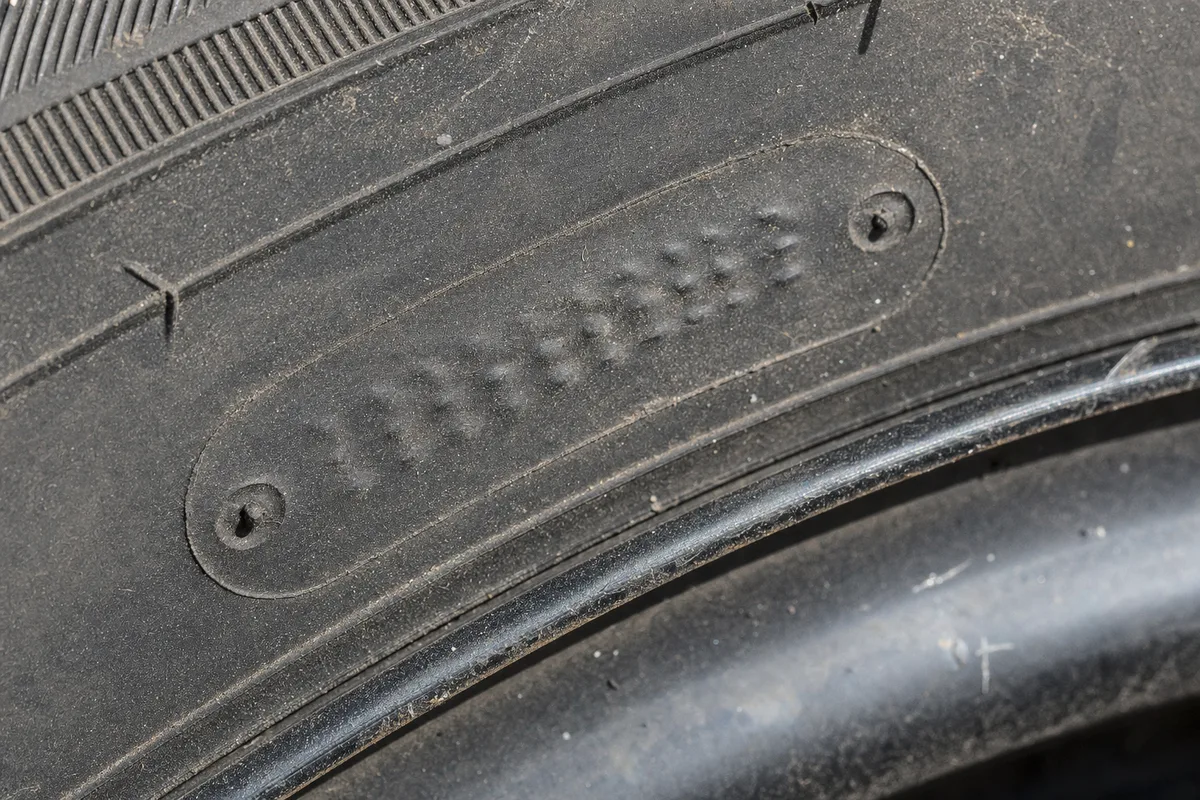
Finding the DOT code on the sidewall
Look for the letters DOT followed by a string of 8 to 13 characters, molded into the lower sidewall near the rim. On many tires the complete code, with the date, appears on only one side; the other side shows the first part only. If you see DOT and a short code, walk around and check the other sidewall, which may mean looking at the inside face with a flashlight or turning the wheel to full lock.
A full code looks like DOT B9 EU 4X7 0325:
- DOT: certifies the tire meets Federal Motor Vehicle Safety Standards.
- B9: the plant code, identifying the factory (B9 is a Michelin plant, for example). The NHTSA added new three-character plant codes in 2025 as the two-character list ran out.
- EU: tire size code assigned by the manufacturer.
- 4X7: an optional manufacturer code for brand, tread or construction.
- 0325: the date. Week 03 of 2025, meaning mid-January 2025.
Since 2015 the date portion has often been set off in a slightly raised oval, which makes it easier to spot.
Converting the week number to a month
Weeks are counted from the first week of January, so a rough conversion is: divide the week number by 4.3 to get the month.
| Week code | Approximate month |
|---|---|
| 01 to 05 | January |
| 06 to 09 | February |
| 10 to 13 | March |
| 14 to 18 | April |
| 19 to 22 | May |
| 23 to 26 | June |
| 27 to 31 | July |
| 32 to 35 | August |
| 36 to 39 | September |
| 40 to 44 | October |
| 45 to 48 | November |
| 49 to 52 | December |
Tires made in 1999 or earlier carried a three-digit code such as 158 (15th week, 1998, or 1988; the decade was ambiguous). Some 1990s tires added a small triangle after the three digits to indicate that decade. If you find a three-digit code on a tire in service, replace it today. Those tires are at least 27 years old.
How old is too old?
There is no federal expiration rule, so the guidance comes from manufacturers and automakers, and it converges on the same range:
- 5 years: begin annual professional inspection (Michelin, Bridgestone, Continental, Goodyear).
- 6 years: recommended replacement point in the owner's manuals of Ford, GM, Toyota, Nissan, Mercedes-Benz and others, regardless of tread.
- 10 years: absolute maximum service life stated by the tire makers, including the spare.
Why age matters: the rubber compound loses its plasticizers and the bonds between rubber and steel belts weaken through oxidation. The tire looks fine, still has tread, but its wet grip is reduced and its risk of tread separation at highway speed climbs. Sunlight, heat and ozone accelerate this, so a tire on a car parked outside in Phoenix ages faster than one in a garage in Vermont. Very low use is also bad: tires on a boat trailer, motorhome or collector car that sit for months often crack before they wear.
The spare deserves a look too. A full-size spare in a 2014 truck is a 12-year-old tire, and a temporary spare that old should be replaced before you need it at 65 mph.
Cracking, weather checking and other visual clues
The date tells you the calendar age; the sidewall tells you how the tire actually aged.
- Fine surface cracks in the sidewall (weather checking): common after 5 or 6 years. Shallow, cosmetic cracks are usually acceptable; cracks you can catch a fingernail in are not.
- Cracks at the base of tread blocks: indicates the compound has hardened; expect poor wet grip.
- Brown or gray bloom: antiozonant waxes migrating out of the rubber. Harmless by itself, but a sign the tire has been sitting.
- Bulges or waviness: belt separation. Replace immediately.
- Hard, glossy rubber: press a thumbnail into the tread. New rubber gives; ten-year-old rubber feels like plastic.
Tire shine products containing petroleum distillates can speed up cracking, so use water-based dressings if you use any at all. Our replacement guide covers tread depth and wear patterns alongside age.
Buying new tires: how fresh should they be?
There is no rule that a new tire must be sold within a certain time, but the industry norm is that tires up to about 18 months to 2 years old are sold as new without issue. Big online sellers like Tire Rack and Discount Tire turn over stock quickly and rarely ship anything older than a year. Small shops, warehouse clubs on a slow-moving size, and closeout deals are where you can occasionally get a tire that is three or four years old.
Practical advice:
- Check the DOT date before the tire goes on the wheel, and ask for a different one if it is older than two years. Most shops will swap without argument.
- Buying an unusual size, a discontinued model or a clearance deal? Assume the stock may be older and ask beforehand.
- A tire that is two years old on the shelf has still aged less than one that has been on a car for two years. Storage in a cool, dark warehouse is gentle. It is not a reason to reject an otherwise good deal, but it should not be older than that.
- The manufacturer warranty typically runs from the purchase date, not the DOT date, with a cap at 5 or 6 years from manufacture. See tire warranties explained.
Used tires: the one case where the DOT date is everything
Used tires are a gamble, and the DOT date is your best odds-changer. A used tire with 8/32 in of tread from 2019 is a worse buy than one with 7/32 in from 2024. Beyond the date:
- Check for a repair patch on the inside before mounting; a good shop will show you.
- Inspect the inner sidewall for a rubbed ring, which indicates the tire was driven flat.
- Match all four tires on AWD vehicles, or you may damage the differential.
- Used tires typically sell for 25 to 50 percent of new. With rebate seasons and budget brands, a new tire from a brand such as General or Kumho is often not much more and comes with a warranty.
The NHTSA has recalled tires for aging-related failures, and the agency lets you look up recalls by DOT code at its website. It takes a minute and is worth doing on any used tire and on the tires of any used car you buy.
Frequently asked questions
What does the DOT number on a tire tell you?
It identifies the factory, the size and the manufacture date. The last four digits are the week and year the tire was built, so 4523 means the 45th week of 2023. The full code appears on at least one sidewall; the other side may show only the first part.
Are 7-year-old tires safe?
They may be, if they show no cracking and have been stored away from heat and sun. Many automakers recommend replacement at six years, and all tire makers say to have tires over five years old inspected annually. If the sidewalls show cracks you can catch a fingernail in, replace them.
How old can a new tire be when I buy it?
There is no legal limit, but the norm is that anything under about two years is sold as new. Check the code before installation and ask for fresher stock if a tire is older than that. Most reputable retailers will swap it.
Does a tire have an expiration date?
Not a printed one. Manufacturers state a maximum service life of ten years from the DOT date, including time in storage and as a spare, and recommend inspection every year after five. The tire's condition, not just the date, decides whether it is safe.
Why can I only see part of the DOT code?
Regulations require the full code, including the date, on only one sidewall. The other side may carry a shortened version. Check the inside sidewall of the tire with a flashlight, or turn the steering wheel to see the inner face of the front tires.
Updated September 2026.