
Tire Pressure: The Right PSI and Why It Matters
The correct pressure for your tires is printed on the sticker in the driver's door jamb, and for most cars it is between 30 and 36 psi. It is not the number on the tire sidewall; that is the maximum the tire can hold, typically 44 or 51 psi, and it is the wrong pressure for your car. Check pressure cold, before driving, once a month.
Pressure drops about 1 psi for every 10 F fall in temperature, which is why the TPMS light comes on during the first cold snap of fall, and it leaks about 1 psi a month through the rubber itself. Underinflation is the most common tire problem in the US. Here is the whole picture, including whether nitrogen is worth paying for.
Door sticker, not sidewall: where the right number lives
The tire placard is a sticker on the driver's door jamb (sometimes on the door edge, glove box lid or fuel door). It lists the original tire size and the cold inflation pressure for front and rear, which the automaker chose to balance ride, handling, load capacity and fuel economy for that vehicle. Many trucks and some cars list different pressures front and rear, and pickups often list a higher rear pressure for loaded conditions.
The sidewall number is something else entirely. Max Press 51 psi means the tire can safely hold 51 psi and carry its maximum load at that pressure. Filling a Camry that calls for 35 psi to 51 psi makes it ride like a wheelbarrow, wears the center of the tread, cuts wet grip and does not add safety.
Two exceptions worth knowing: if you have changed to a different tire size or from P-metric to LT tires, the placard pressure may no longer apply, and a tire dealer or a load-inflation table from the tire maker gives the correct figure. And if you tow or load a truck heavily, the placard or manual usually gives a higher loaded pressure.
Cold pressure and the temperature effect
Pressure specs are cold pressures, meaning the tire has not been driven more than a mile or so in the last three hours. Driving heats the air inside and raises pressure by 3 to 5 psi, so a tire that reads 35 psi after a highway run may be at 31 psi cold. Never bleed air out of a hot tire to bring it down to the placard number.
Ambient temperature changes pressure too, at roughly 1 psi per 10 F. Set to 35 psi on a 75 F afternoon in September, and the first 25 F morning in November will read 30 psi, right at the point where most TPMS systems trigger.
Practical routine:
- Check monthly, cold, in the morning before the first drive.
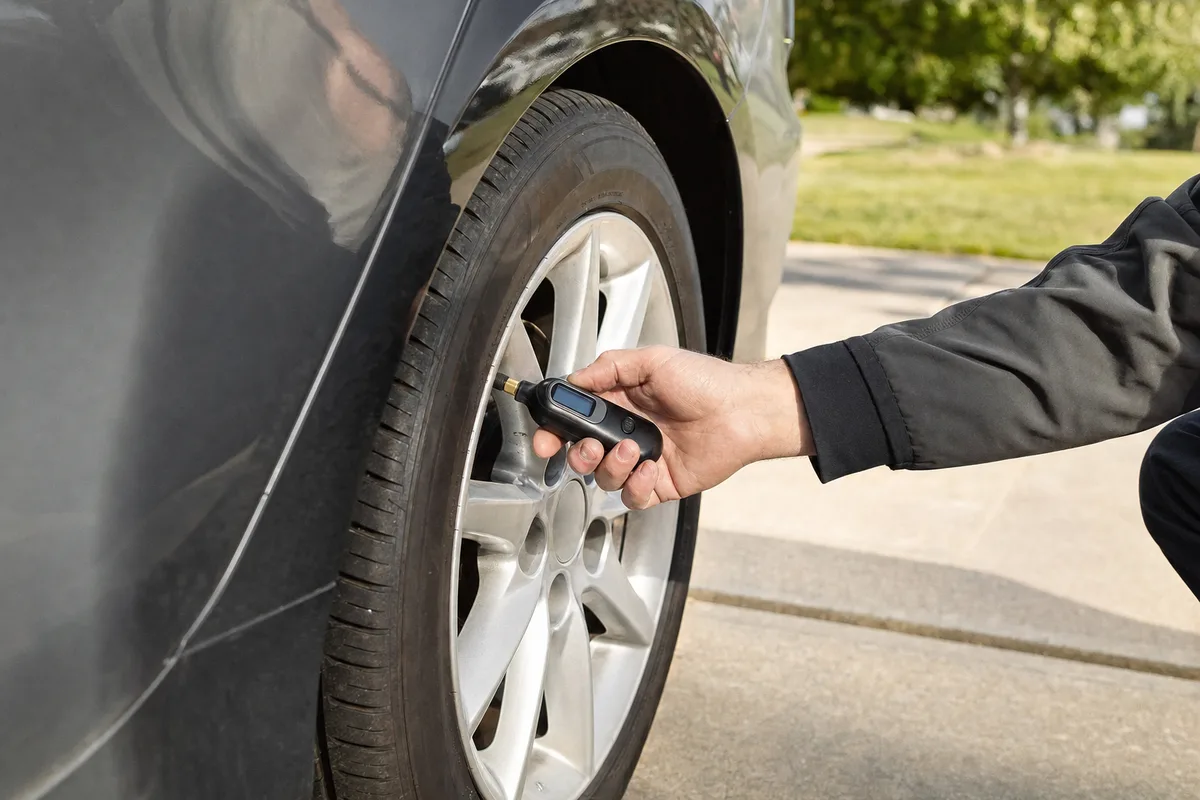
- Use your own gauge; gas station gauges are often off by 3 to 5 psi. A good one costs $10 to $20.
- Recheck when the season changes, when the TPMS light comes on, and before a road trip with a loaded car.
- Do not forget the spare: a temporary spare usually needs 60 psi and is nearly always found flat when needed.
What underinflation and overinflation cost you
| Condition | Effect |
|---|---|
| 6 psi under (about 20 percent low) | About 2 percent worse fuel economy, tread life reduced by up to 25 percent, both outer edges wear, hotter running, longer wet stops |
| 10 psi under | Sidewall flexing generates enough heat to damage the tire structure; this is the classic cause of highway blowouts |
| Driven flat for even a short distance | Internal damage; most shops will not repair a tire that has been run flat |
| 5 psi over | Harsher ride, center tread wear, slightly less wet grip, marginally better fuel economy |
| At sidewall maximum | Significantly reduced contact patch, poor wet braking, harsh ride, center wear; no safety benefit |
The NHTSA estimates that underinflated tires contribute to hundreds of fatalities a year in the US and that a quarter of cars on the road have at least one tire 8 psi or more below spec. The tread-life cost is the one you feel: $700 tires lasting 45,000 miles instead of 60,000 is $175 lost.
The TPMS light: what it means and what to do
Every car sold in the US since the 2008 model year has a tire pressure monitoring system (TPMS), required by the TREAD Act. Two kinds exist:
- Direct TPMS: a battery-powered sensor inside each wheel measures pressure and transmits it. Most cars. Sensor batteries last 7 to 10 years; a new sensor costs $40 to $80.
- Indirect TPMS: uses the ABS wheel-speed sensors to detect a tire rolling at a slightly different speed because it is smaller when low. It needs a reset after any inflation change and cannot show actual psi.
What the lights mean:
- Steady yellow horseshoe with an exclamation point: at least one tire is 25 percent or more below the placard pressure, the federal trigger point. Check all four cold and inflate. On a 35 psi car that is about 26 psi, already well into the danger zone.
- Flashing for 60 to 90 seconds, then steady: a system fault, usually a dead sensor battery, a sensor missing from a winter wheel set, or a sensor that has not been registered after a tire change.
- Light stays on after inflating: drive a few miles at over 25 mph to let the sensors update, or perform the relearn procedure in the manual. Indirect systems always need the manual reset.
The system is a backstop, not a substitute for the monthly gauge check.
Nitrogen: worth paying for?
Nitrogen-filled tires (green valve caps) are sold on the basis that nitrogen molecules are larger than oxygen and leak through rubber more slowly, and that nitrogen carries no moisture, so pressure is more stable with temperature. Both claims are true and both are small. Consumer Reports measured a year-long loss of 2.2 psi for nitrogen versus 3.5 psi for air, a difference of about 1.3 psi a year. Air is already 78 percent nitrogen.
What to do with that:
- If it is free (Costco, some dealers), take it; topping up with regular air later is fine.
- If it costs $5 to $10 per tire, skip it and buy a $15 gauge instead. Checking monthly beats any gas.
- Aircraft and race cars use nitrogen for reasons (extreme temperature swings, fire safety) that do not apply to a Corolla.
Nitrogen does not change the correct pressure, and it does not prevent the 1 psi per 10 F drop; that is basic gas physics.
Special cases: trucks, trailers, EVs and spares
- Light trucks with LT tires: the placard often lists 60 to 80 psi rear for maximum payload. Running an empty three-quarter-ton at 80 psi rear beats your kidneys and wears the center. Use the tire maker's load-inflation table to pick a pressure for the actual load, often 45 to 55 psi when empty. Never go below the front placard figure. See the truck and SUV tire guide.
- Trailers: ST tires run at their sidewall maximum, usually 50 to 80 psi, because trailer tires are loaded near their limit. This is the one case where the sidewall number is the correct number.
- EVs: heavy cars with high placard pressures, often 40 to 45 psi. Underinflation costs range noticeably, several percent per 5 psi. See do EVs need special tires.
- Loaded for a road trip: add 2 to 3 psi to the rear if the manual gives no loaded figure.
Frequently asked questions
What tire pressure should I use?
The cold pressure printed on the tire placard in the driver's door jamb, usually 30 to 36 psi for cars and up to 80 psi for heavy-duty trucks. Do not use the number on the tire sidewall; that is the tire's maximum, not the recommendation for your car.
Is 40 psi too high for tires?
For most cars with a 32 to 35 psi placard, 40 psi is high enough to wear the center of the tread and harshen the ride, though it is within the tire's limit. Some EVs and heavy SUVs specify 40 psi or more on the placard, and for them it is correct. Follow the sticker.
Why does my tire pressure light come on when it is cold?
Air contracts as it cools, roughly 1 psi for every 10 F. A tire set to 35 psi in summer can read 29 or 30 psi on the first cold morning, below the 25 percent threshold that triggers the light. Top up to the placard pressure cold and the light will go out after a short drive.
Is nitrogen in tires worth it?
Only if it is free. Nitrogen leaks slightly more slowly than air, about 1 psi a year of difference in testing, and it does not change the correct pressure or prevent the temperature drop. A monthly check with your own gauge does far more than any gas.
Updated September 2026.