
Tire Rotation, Balancing and Alignment Explained
Three different services, three different problems. Rotation moves tires between positions every 5,000 to 8,000 miles so they wear evenly. Balancing adds small weights to the wheel so it spins without vibration. Alignment adjusts the suspension angles so the tires point straight and sit flat on the road. Skip rotation and your front tires wear out 15,000 miles early; skip alignment and a new set can be ruined on one edge in a single season.
Typical costs: rotation $20 to $40 (free for life at many tire retailers), balancing $10 to $20 per wheel, alignment $80 to $200. Here is what each one does, how often you need it, which rotation pattern fits your drivetrain, and the symptoms that tell you which of the three is calling.
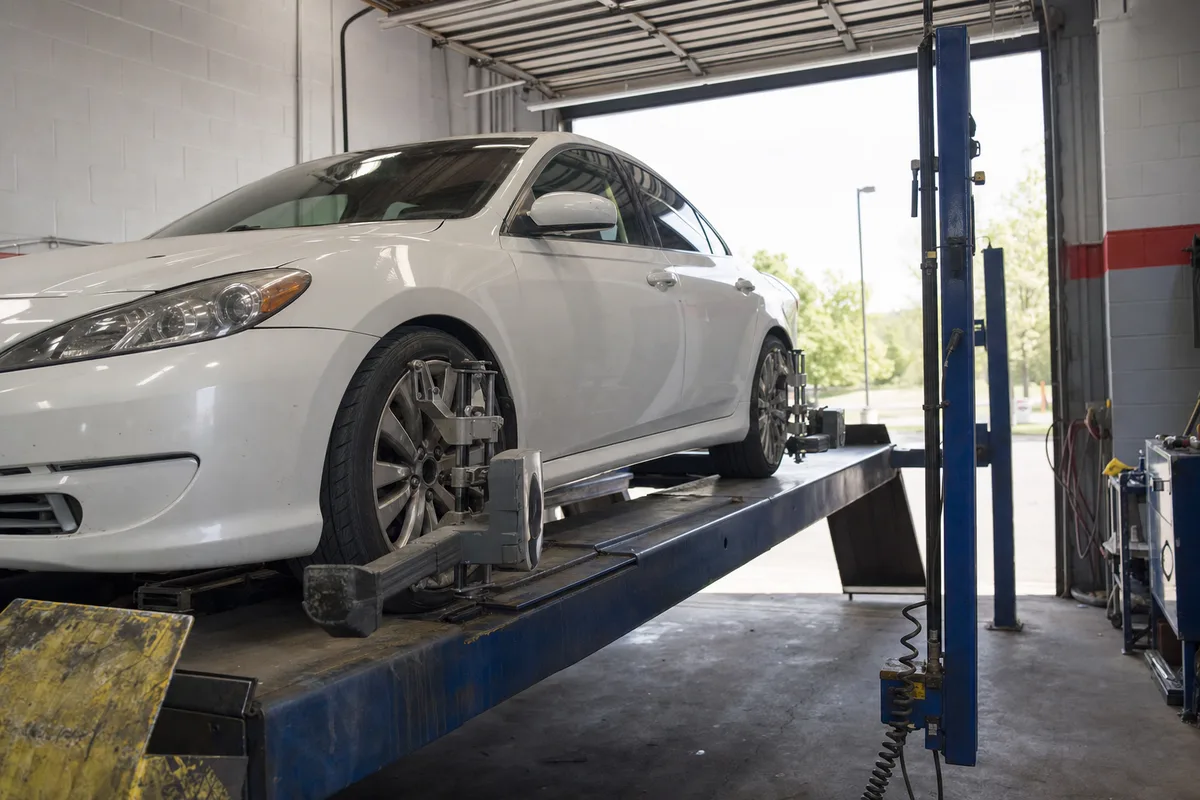
Rotation: why and how often
Front tires on a front-wheel-drive car steer, carry 60 percent of the weight and deliver all the power and most of the braking. They can wear twice as fast as the rears. On a rear-wheel-drive car the difference is smaller but the rears still wear faster from acceleration. Rotating swaps positions so all four reach the end of their life together, which lets you replace them as a matched set and, importantly, keeps the mileage warranty valid.
- Interval: every 5,000 to 8,000 miles. Most owner's manuals say 5,000 to 7,500 miles; a convenient rule is every other oil change, or every oil change on a 7,500 mile oil interval.
- Warranty requirement: mileage warranties from Michelin, Goodyear, Bridgestone and others require documented rotations at roughly those intervals. Keep receipts.
- Cost: $20 to $40 at a shop; free for life on tires bought at Discount Tire, Costco, Walmart, Sam's Club and most chains. Doing it yourself needs a jack, two jack stands and a torque wrench.
- Torque: lug nuts should be tightened to the manual's spec, usually 80 to 100 lb-ft on cars and 130 to 150 lb-ft on trucks, in a star pattern.
Rotation patterns by drivetrain
| Vehicle | Pattern | Details |
|---|---|---|
| Front-wheel drive | Forward cross | Fronts move straight back; rears cross to the opposite front (rear left to front right) |
| Rear-wheel drive, 4WD | Rearward cross | Rears move straight forward; fronts cross to the opposite rear |
| All-wheel drive | X pattern or rearward cross | All four swap diagonally, or use the rearward cross; the manual decides |
| Directional tires (arrow on sidewall) | Front to back only | Same side, since the tire can only roll one way |
| Staggered (wider rears) | Side to side only, if non-directional | Different sizes cannot swap axles; directional staggered tires cannot be rotated at all |
| Full-size matching spare | Five-tire rotation | Spare enters at right rear, keeps all five aging evenly; popular on Jeeps and trucks |
Dual rear wheel trucks and vehicles with different front and rear pressures need extra care: after rotating, reset each tire to the pressure listed for its new position on the door placard. Also reset the TPMS location if your car tracks pressure per corner; many do this automatically after a few miles.
Balancing: curing the 60 mph shake
No tire and wheel assembly is perfectly even. A few tenths of an ounce of imbalance at 65 mph is enough to shake the steering wheel. Balancing spins the wheel on a machine and adds clip-on or adhesive weights, usually a quarter to two ounces, to cancel it.
- When: every time a tire is mounted, and whenever you feel a vibration that starts around 50 to 55 mph and peaks at 60 to 70 mph. Steering wheel shake usually means a front wheel; a shake in the seat means a rear wheel.
- Not needed just because the tires have been rotated, though many shops rebalance at rotation for a small fee and it is a reasonable add-on every 12,000 to 15,000 miles as tread wears.
- Road-force balancing: a Hunter or similar machine presses a roller against the tread to measure stiffness variation and can suggest rotating the tire on the rim to cancel it. Costs $10 to $15 more per wheel. Try it when a standard balance does not fix a vibration.
- Lost weights: adhesive weights fall off in car washes and with age.
A vibration that balancing cannot fix points to a bent wheel, a tire with a separated belt, a warped brake rotor (felt under braking), or worn suspension bushings.
Alignment: the three angles
Alignment sets the wheels to the angles the manufacturer specified. Three angles matter:
- Toe: whether the front of the wheels point slightly in or out, measured in fractions of a degree or in inches. Toe is the biggest tire killer. A toe error of 1/8 in drags the tire sideways about 30 ft for every mile, which feathers the tread blocks and can wear a new tire out in 10,000 miles.
- Camber: the tilt of the top of the wheel in or out. Negative camber (top in) wears the inside edge; positive wears the outside. Lowered cars and worn springs push camber negative.
- Caster: the forward or backward tilt of the steering axis. Affects straight-line stability and steering return; rarely adjustable on modern cars, but a difference side to side causes a pull.
A front-end alignment adjusts the front wheels; a four-wheel alignment also sets the rears (needed on most modern cars with independent rear suspension) and lines the fronts up with the rear thrust angle. Typical cost: $80 to $130 front, $120 to $200 four-wheel. Some chains sell lifetime alignment for around $200 to $250, which pays off if you keep the car and live near potholes.
Symptoms: which service does your car need?
| Symptom | Most likely need |
|---|---|
| Vibration at 55 to 70 mph, smooth below | Balancing |
| Car pulls to one side on a flat road | Alignment (or a tire with a belt problem; swap fronts side to side to check) |
| Steering wheel off-center when driving straight | Alignment |
| Inside or outside edge of a tire worn bald | Alignment, then replace tire |
| Tread blocks feel sawtoothed when you run your hand across | Alignment (toe) |
| Front tires much more worn than rears | Rotation overdue |
| Cupped or scalloped wear around the tire | Worn shocks or struts, then balance |
| Squealing in slow corners on dry pavement | Alignment (toe) |
| Vibration under braking only | Warped brake rotors, not tires |
Alignment should be checked after any pothole hard enough to make you wince, after a curb strike, after replacing struts, tie rods, ball joints or control arms, and after lifting or lowering the vehicle. New tires do not by themselves require an alignment if the old ones wore evenly; a check, often free, tells you either way. Compare with our wear pattern guide and installation cost guide.
A maintenance schedule that protects your tire investment
- Monthly: check pressure cold against the door placard and glance at tread across the width. See the tire pressure guide.
- Every 5,000 to 7,500 miles: rotate. Have the shop note tread depth at each corner on the invoice; a difference of more than 2/32 in between axles means you waited too long.
- Every 12,000 to 15,000 miles: rebalance if any vibration has crept in.
- Every 12 months or 12,000 miles: alignment check, especially in pothole country. Adjust only when out of spec.
- With every new set: balance always; alignment check, and adjust if the old tires wore unevenly.
- After a pothole or curb: inspect for bulges, check alignment if the steering wheel is off-center.
Done consistently, this routine gets a 60,000 mile tire to 60,000 miles. Skipped, the same tire is done at 35,000, with the front pair going first.
Frequently asked questions
How often should tires be rotated?
Every 5,000 to 8,000 miles, or as the owner's manual specifies, which is usually 5,000 to 7,500. Tying it to oil changes is the easiest way to remember, and documented rotations are required to keep most mileage warranties valid.
What is the difference between balancing and alignment?
Balancing corrects weight distribution around the wheel so it does not vibrate; it involves adding small weights to the rim. Alignment adjusts the suspension so the wheels point straight and sit flat on the road; it involves turning adjusters on tie rods and control arms. Vibration points to balancing, pulling and edge wear point to alignment.
Do AWD cars need a special rotation pattern?
Most AWD manuals specify a rearward cross or a simple front-to-back rotation. More important on AWD is keeping all four tires within 2/32 to 4/32 in of each other in tread depth, which regular rotation ensures and which protects the center differential.
How much does an alignment cost?
Typically $80 to $130 for a front alignment and $120 to $200 for a four-wheel alignment in 2026, with lifetime packages around $200 to $250 at some chains. Many shops offer a free or $20 alignment check that prints the actual angles, so you only pay when something is out of spec.
Updated September 2026.