
Truck and SUV Tires: Highway, All-Terrain or Mud-Terrain?
For most trucks and SUVs the honest answer is a highway tire if the vehicle lives on pavement, a mild all-terrain if it sees gravel, snow, boat ramps or a job site every week, and a mud-terrain only if it regularly leaves the road. Every step toward the mud-terrain buys off-road traction and pays for it in noise, wet braking, fuel and tread life. The second decision is load: P-metric for a crossover or an unloaded half-ton, LT with load range C, D or E for towing, hauling and anything three-quarter-ton and up.
Below: the three tread types, load range letters in pounds and psi, LT versus P-metric, towing math, plus sizing, and the common sizes 265/70R17, 275/65R18, 275/55R20 and 33x12.50R20.
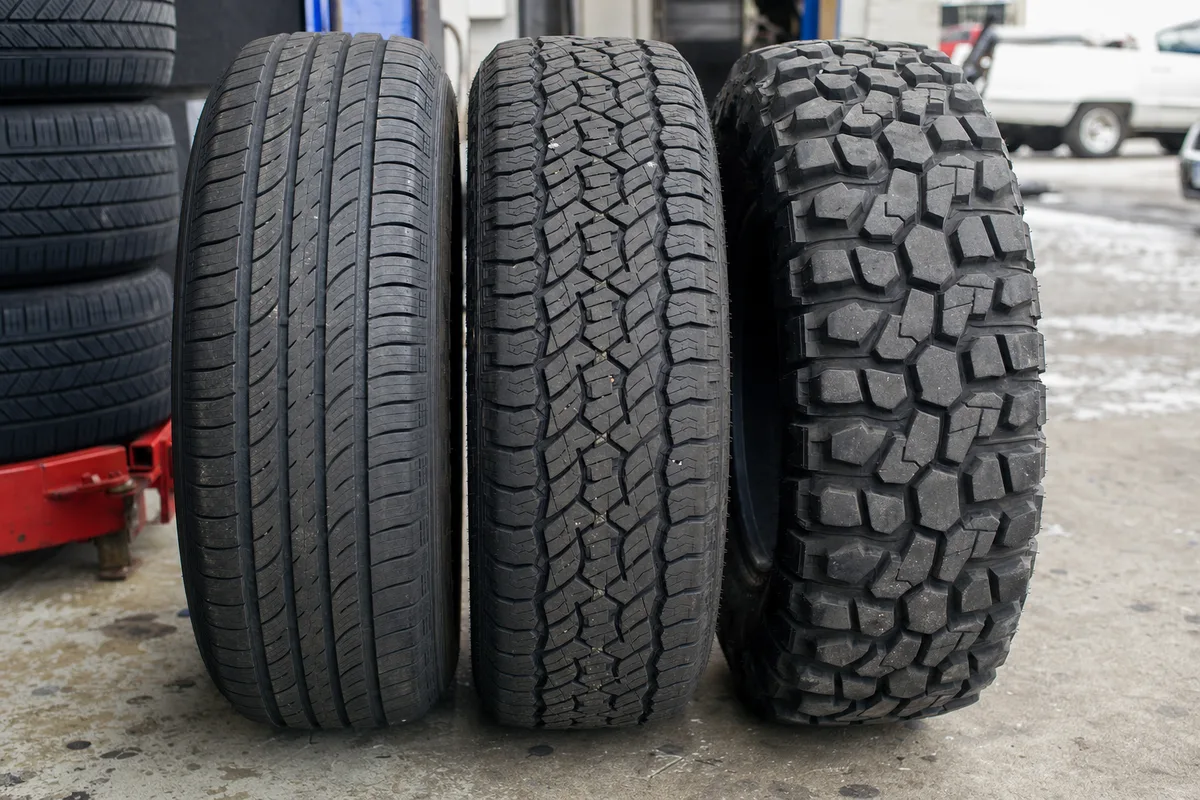
Highway, all-terrain, mud-terrain: the trade-offs
| Highway (H/T) | All-terrain (A/T) | Mud-terrain (M/T) | |
|---|---|---|---|
| Tread | Rib pattern, dense siping | Interlocking blocks, open shoulders | Huge lugs, wide voids, sidewall biters |
| Pavement grip, wet | Best | Good | Weakest; longer stops |
| Snow | Fair; some carry 3PMSF | Good; many 3PMSF (KO2, Wildpeak AT3W, Ridge Grappler, Grabber ATX) | Poor on packed snow and ice despite the look |
| Gravel, dirt, mud | Adequate on gravel | Good; self-cleaning on most surfaces | Best in mud, rocks, sand |
| Noise | Quiet | Mild hum | Loud; roars above 45 mph |
| Tread life | 60,000 to 80,000 mi | 50,000 to 65,000 mi | 30,000 to 40,000 mi |
| Fuel penalty vs H/T | Baseline | 1 to 3 percent | 4 to 8 percent |
| Examples | Michelin Defender LTX M/S2, Bridgestone Dueler H/L Alenza | BFGoodrich KO3, Falken Wildpeak A/T4W, Toyo Open Country A/T III | BFGoodrich KM3, Toyo Open Country M/T, Nitto Trail Grappler |
The hybrid or rugged-terrain category (Nitto Ridge Grappler, Toyo Open Country R/T) sits between A/T and M/T and suits lifted trucks that commute on the freeway. Browse the all-terrain and highway truck and SUV categories.
| Tire | Pavement | Gravel | Mud | Quiet | Tread life |
|---|---|---|---|---|---|
| Highway (H/T) | 5 of 5 | 3 of 5 | 1 of 5 | 5 of 5 | 5 of 5 |
| All-terrain (A/T) | 4 of 5 | 5 of 5 | 3 of 5 | 3 of 5 | 4 of 5 |
| Mud-terrain (M/T) | 2 of 5 | 4 of 5 | 5 of 5 | 1 of 5 | 2 of 5 |
Relative capability across five things truck owners care about. Most pickups that never leave pavement are better served by a highway tire than by the aggressive tread they look better with.
Load range C, D, E, F in plain numbers
The load range letter replaces the old ply rating and tells you how much pressure the casing holds, which sets the weight it carries.
| Load range | Ply rating | Max psi | Example load, 265/70R17 | Typical vehicle |
|---|---|---|---|---|
| C | 6 | 50 | about 2,470 lbs (index 112) | Half-ton, mid-size SUV, Tacoma, 4Runner |
| D | 8 | 65 | about 2,760 lbs (index 118) | Half-ton that tows, heavier SUVs |
| E | 10 | 80 | about 3,195 lbs (index 121) | F-250/350, Ram 2500/3500, Silverado HD, heavy towing |
| F | 12 | 95 | 3,750 lbs and up (index 126+) | One-ton duallies, commercial |
Two things people get wrong. First, an E tire only carries its full load at 80 psi; run it at 40 psi on an empty truck and its capacity drops to roughly what a C tire provides, which is fine for an empty truck and much better for ride. Use the tire maker's load-inflation table for the actual load, never below the placard front figure. Second, more load range is not automatically safer: an E tire on a Tacoma that never tows rides hard and adds 10 lbs per corner. Match the load range to the placard and what you actually carry.
LT vs P-metric: which does your truck need?
The door placard decides. Half-ton trucks (F-150, Silverado 1500, Ram 1500, Tundra, Titan) and nearly all SUVs and crossovers come with P-metric or Euro-metric tires from the factory, because those ride better and are lighter. Three-quarter-ton and heavier trucks come with LT tires. Rules:
- If the placard shows LT, replace with LT of the same or higher load range. No exceptions.
- If the placard shows P-metric, you may fit LT for heavier towing, more sidewall puncture resistance off-road, or a lifted setup. Expect a stiffer ride, more weight per wheel, slightly worse fuel economy and higher pressures.
- A P-metric tire used on a truck or SUV must have its load capacity reduced by dividing by 1.10, per industry standard, because trucks load tires harder. A P265/70R17 rated at 2,469 lbs counts as 2,245 lbs. Automakers already account for this on the placard.
- Do not mix LT and P-metric on the same axle.
For an F-150 that tows a 7,000 lb trailer a few times a year, a load range C or D LT is a sensible upgrade; for a Highlander that tows nothing, P-metric is correct.
Towing and hauling: doing the math
The tires carry the truck, payload and tongue weight (10 to 15 percent of trailer weight for a bumper pull, 15 to 25 percent for a fifth wheel, nearly all on the rear axle):
- Find the rear gross axle weight rating (GAWR) on the door placard; on a half-ton it is typically 3,800 to 4,300 lbs, on a three-quarter-ton 6,000 to 6,500 lbs.
- Divide by two for the per-tire requirement, and check that the tire's load index at your running pressure covers it with 10 to 15 percent margin.
- For a fifth wheel with a 2,500 lb pin weight on a Ram 2500, the rear axle can sit near 6,000 lbs, or 3,000 per tire: that is E-range territory at 80 psi (121 index, 3,195 lbs), which is why HD trucks ship with E tires.
- Trailer tires are a separate subject: ST tires at their sidewall maximum pressure, replaced every 5 to 6 years regardless of tread, speed-rated typically to 65 or 75 mph.
Pressure while towing: raise the rear tires to the placard's loaded figure or to the load-inflation table value for the actual axle weight, and check them cold before every trip. Stiff-sidewall highway tires tow more stably than soft-shouldered all-terrains; mud-terrains squirm under a heavy trailer.
Swipe to compare tread types
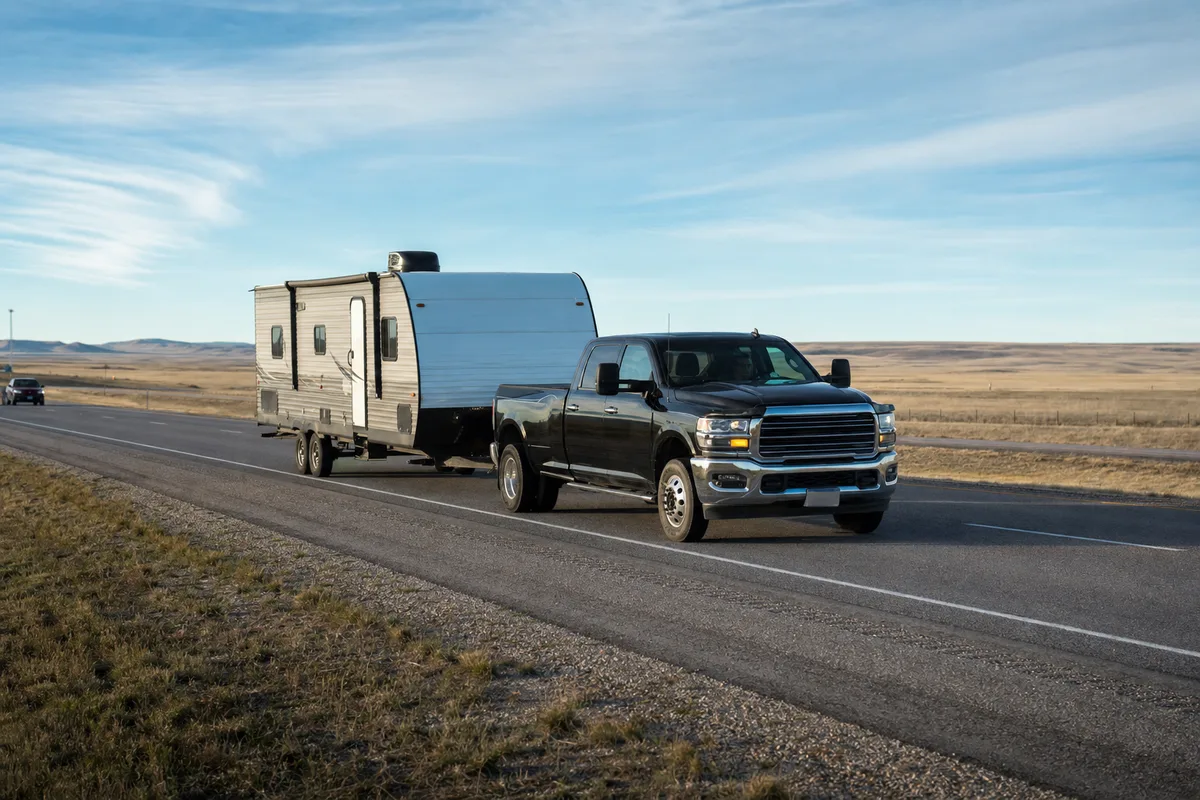
Highway Truck & SUV Tires
Long-wearing, quiet tires for pickups and SUVs that stay on pavement.

All-Terrain Tires
Truck and SUV tires for dirt, gravel and snow that still drive fine on the highway.
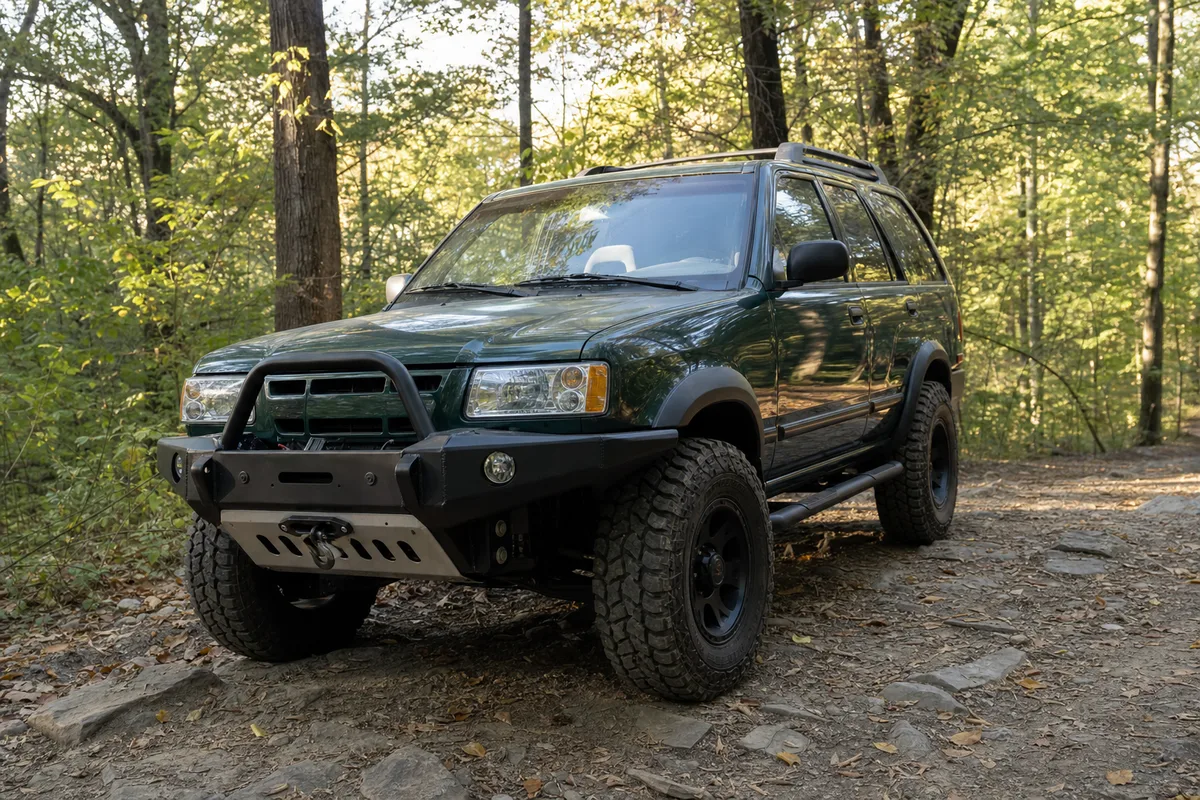
Mud-Terrain Tires
Aggressive off-road tires with big tread blocks for mud and rock; loud on pavement.
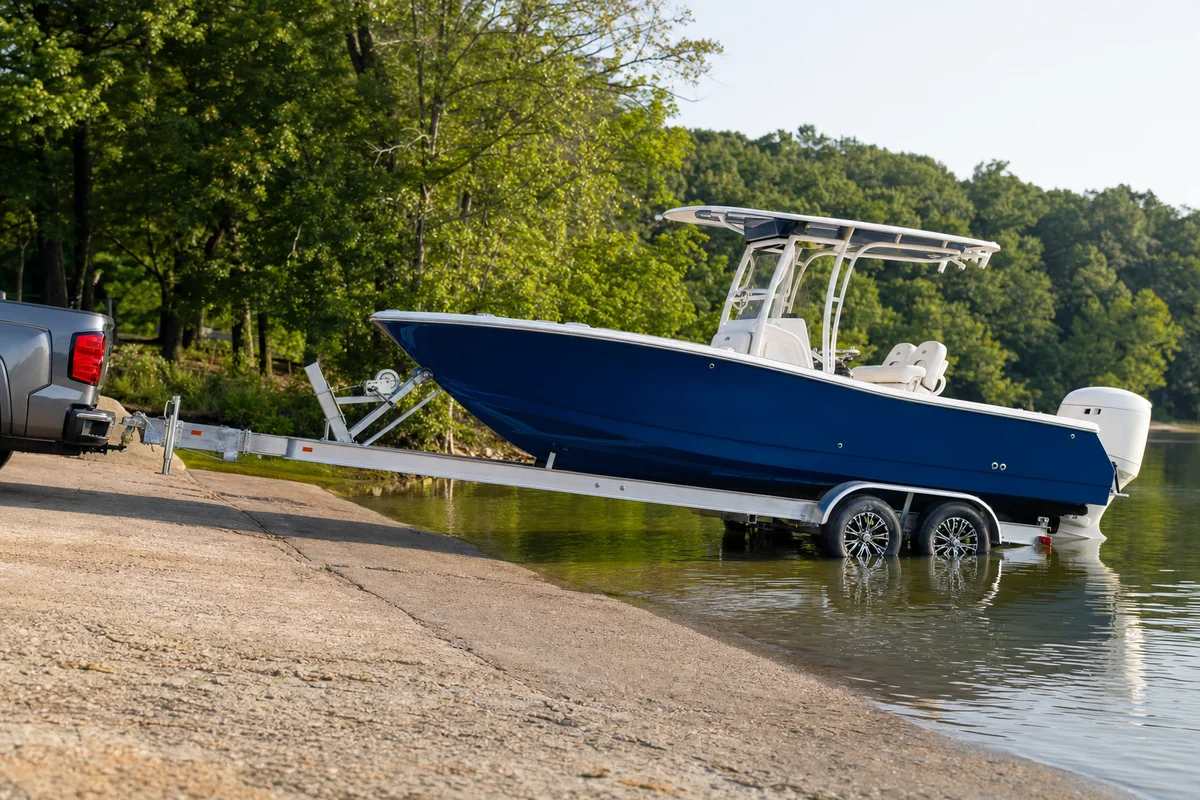
Trailer Tires
ST-rated tires built for the sideways loads and heat of towing a trailer, never for a car.
Plus sizing, lifts and bigger tires
Fitting a taller tire changes clearance, gearing and readings:
- Stock to +1 in diameter (265/70R17 to 275/70R17, about 0.6 in taller): usually fits without a lift on most half-tons, and speedometer error is under 2 percent.
- 33 in tires (285/70R17, 275/70R18, 33x12.50R20): typically needs a 2 to 2.5 in leveling kit on an F-150, Ram 1500 or Tacoma and may rub at full lock without trimming. Speedometer reads 3 to 5 percent slow; recalibrate.
- 35 in tires: 3 to 4 in of lift, often re-gearing (3.73 to 4.10 or 4.56) and heavier steering parts. Fuel economy drops 2 to 4 mpg.
- Load rating after sizing up: check it; some 20 in low-profile sizes drop below the placard index.
Flotation sizes (33x12.50R20) read diameter x width R wheel; metric sizes need a calculator. Both formats are listed on our size pages with the measured diameter for each model, since a nominal 33 can be 32.4 to 33.2 in in reality.
The popular sizes and what fits them
- 265/70R17: 31.6 in tall. Tacoma, 4Runner, F-150, Silverado 1500, Ram 1500, Wrangler Sahara, Colorado. The most common truck size in the US.
- 275/65R18: 32.1 in. F-150 (most trims), Expedition, Silverado 1500 with 18 in wheels, Ram 1500, Tundra, Sequoia.
- 275/55R20: 31.9 in. F-150 Lariat and Platinum, Silverado and Sierra 1500 with 20 in wheels, Ram 1500 Laramie, Tahoe, Yukon, Expedition. Mostly P-metric highway and mild A/T tires.
- 33x12.50R20: lifted half-tons and Jeeps, F-250 Tremor and Ram Rebel style builds. Almost entirely LT, load range E, all-terrain and mud-terrain, 65 to 75 lbs per tire.
- LT275/70R18 and LT275/65R20: F-250, F-350, Ram 2500, Silverado HD factory sizes; E range, 80 psi.
For any of them, decide the type first (highway, A/T, M/T), then the load range the placard and your towing need, then look for the 3PMSF symbol if you drive in snow, and only then compare brands: BFGoodrich, Toyo, Falken and Nitto dominate the all-terrain and mud-terrain shelves, while Michelin, Bridgestone and Continental lead in highway tires.
Frequently asked questions
Are all-terrain tires good for daily driving?
A modern mild all-terrain like the BFGoodrich KO3 or Falken Wildpeak A/T4W is entirely livable on pavement, with a slight hum, a small fuel penalty of 1 to 3 percent and wet braking a car length or so behind a highway tire. If the truck never leaves pavement, the highway tire is quieter, cheaper per mile and safer in the rain.
What does load range E mean?
A 10-ply-rated LT casing that can be inflated to 80 psi and carry its full rated load, typically 3,000 to 3,700 lbs per tire depending on size. It is the standard for three-quarter-ton and one-ton trucks and heavy towing. On an empty truck you can run it at lower pressure using the manufacturer's load-inflation table.
Can I put P-metric tires on a truck that came with LT tires?
No. The placard specifies LT for the truck's axle ratings, and a P-metric tire's capacity must be reduced by 10 percent on a truck, leaving it short of the requirement. It also lacks the sidewall strength for loads and trailers. Replace LT with LT of the same or higher load range.
Do mud-terrain tires work in snow?
Poorly on packed snow and ice, despite their aggressive look, because the big lugs have little siping and the compound is hard. Many all-terrain tires carry the 3PMSF snow symbol and are far better in winter. Mud-terrains shine in deep mud, sand and rocks, and are loud and long-stopping on wet pavement.
Updated September 2026.