
Porsche Cayenne tire size
Original tire sizes for the Porsche Cayenne, model years 2003 through 2024. Trim levels and wheel packages change the size within the same year, so confirm on the door-jamb sticker before ordering.
Check before you order. The surest answer is the tires on the car right now: the size is molded into the sidewall. The placard inside the driver's door tells you what the factory fitted, which can differ from what a previous owner put on. Our guide on reading a tire size shows exactly where to look.
Size by year and trim
| Model years | Trim or package | Tire size | From, per tire | |
|---|---|---|---|---|
| 2019-2024 | 21 in alternative | 285/45R21 | $157 | Prices |
| 2019-2024 | 20 in | 285/45R20 | $168 | Prices |
| 2011-2018 | 19 in alternative | 255/50R19 | $116 | Prices |
| 2011-2018 | 20 in | 275/45R20 | $118 | Prices |
| 2003-2010 | Base | 255/55R18 | $106 | Prices |
Tire size by model year
| Model year | Tire size | Trim or package | From, per tire | |
|---|---|---|---|---|
| 2024 Porsche Cayenne | 285/45R21, 285/45R20 | 21 in alternative or 20 in | $157 | Prices |
| 2023 Porsche Cayenne | 285/45R21, 285/45R20 | 21 in alternative or 20 in | $157 | Prices |
| 2022 Porsche Cayenne | 285/45R21, 285/45R20 | 21 in alternative or 20 in | $157 | Prices |
| 2021 Porsche Cayenne | 285/45R21, 285/45R20 | 21 in alternative or 20 in | $157 | Prices |
| 2020 Porsche Cayenne | 285/45R21, 285/45R20 | 21 in alternative or 20 in | $157 | Prices |
| 2019 Porsche Cayenne | 285/45R21, 285/45R20 | 21 in alternative or 20 in | $157 | Prices |
| 2018 Porsche Cayenne | 255/50R19, 275/45R20 | 19 in alternative or 20 in | $116 | Prices |
| 2017 Porsche Cayenne | 255/50R19, 275/45R20 | 19 in alternative or 20 in | $116 | Prices |
| 2016 Porsche Cayenne | 255/50R19, 275/45R20 | 19 in alternative or 20 in | $116 | Prices |
| 2015 Porsche Cayenne | 255/50R19, 275/45R20 | 19 in alternative or 20 in | $116 | Prices |
| 2014 Porsche Cayenne | 255/50R19, 275/45R20 | 19 in alternative or 20 in | $116 | Prices |
| 2013 Porsche Cayenne | 255/50R19, 275/45R20 | 19 in alternative or 20 in | $116 | Prices |
Show the remaining 10 model years
| Model year | Tire size | Trim or package | From, per tire | |
|---|---|---|---|---|
| 2012 Porsche Cayenne | 255/50R19, 275/45R20 | 19 in alternative or 20 in | $116 | Prices |
| 2011 Porsche Cayenne | 255/50R19, 275/45R20 | 19 in alternative or 20 in | $116 | Prices |
| 2010 Porsche Cayenne | 255/55R18 | Base | $106 | Prices |
| 2009 Porsche Cayenne | 255/55R18 | Base | $106 | Prices |
| 2008 Porsche Cayenne | 255/55R18 | Base | $106 | Prices |
| 2007 Porsche Cayenne | 255/55R18 | Base | $106 | Prices |
| 2006 Porsche Cayenne | 255/55R18 | Base | $106 | Prices |
| 2005 Porsche Cayenne | 255/55R18 | Base | $106 | Prices |
| 2004 Porsche Cayenne | 255/55R18 | Base | $106 | Prices |
| 2003 Porsche Cayenne | 255/55R18 | Base | $106 | Prices |
What Porsche approves

Porsche-approved tires are marked N0, N1, N2 and so on. The number is the generation of the approval, not a quality grade.
Porsche tests each tire against the specific car and raises the number every time the spec is revised. Mixing an N0 on one axle and an N2 on the other is not recommended, and on 911 models the front and rear tires are usually different sizes.
Brands that carry the approval





Written on the sidewall as: Michelin Pilot Sport 4S (N0), Pirelli P Zero (N1).
The drawing carries the sizes we list for this car, so you know what you are looking for. The placard on the car is still the final word, and it is the only place that gives the cold pressures: the number molded into the sidewall is the maximum the tire can hold, not what your car wants.
What those tires cost
About the Porsche Cayenne
The Cayenne is Porsche's mid-size luxury SUV, on sale in the US since the 2003 model year and now the car that pays for much of the rest of the lineup. It is a heavy, fast, all-wheel-drive crossover sold in everything from a 300-hp V6 to a 600-plus-hp Turbo GT, which is exactly why tire choice matters here. Most owners land on this page because a dealer quoted a four-figure number for a set of Porsche-approved rubber.
Launched in 2002. Launched in 2002, the Cayenne was Porsche's first SUV and its first V8-engined car since the 928 went out of production in 1995, developed jointly with Volkswagen so that the Cayenne and the VW Touareg shared a platform and a body shop.
How to tell the model years apart
Wheel and tire sizes follow the generation, not the badge, so identifying yours matters before you order.
2003-2010
First generation (9PA/E1)
The original Cayenne is the tall, narrow-eyed one with headlights that sit high in the fender and a hood that slopes sharply toward the bumper. Early cars wear plain body-color bumpers and 17- or 18-inch wheels; the 2008 facelift brought bigger openings and revised lamps. Badges ran base, S, GTS, Turbo and Turbo S, with a diesel added late in the run.
Tire sizes: 255/55R18
2011-2018
Second generation (92A)
Lower and wider looking, with the headlights pulled into the corners and a strong crease running the length of the flank. The tailgate glass is more steeply raked and the tail lights are one-piece rather than split. This is the generation where 19- and 20-inch wheels became the norm and where the S E-Hybrid plug-in first appeared.
2019-2024
Third generation (9YA/E3)
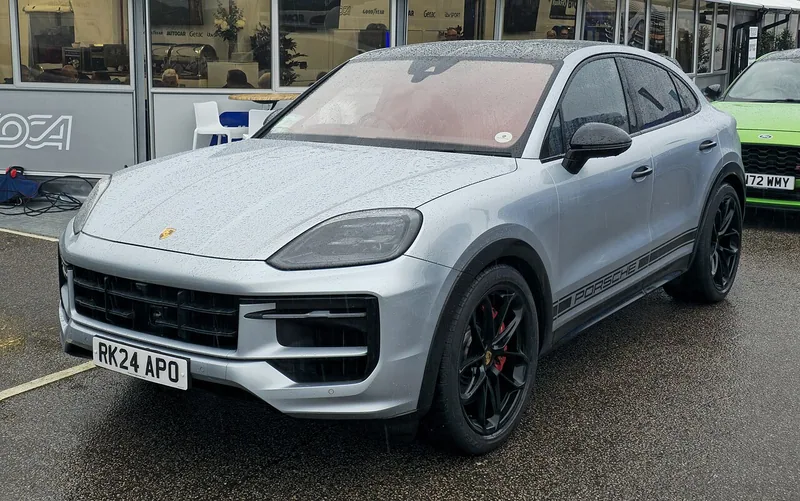
Identified by the full-width light bar across the tailgate with PORSCHE spelled out between the tail lights, and by the raised center crease in the hood. A lower-roof Cayenne Coupe joined in 2019. Wheels start at 19 inches and run to 21 and 22, and mixed-width staggered fitments spread well beyond the Turbo in this generation.
What the press said
The motoring press has been consistent about the Cayenne for two decades: it drives better than a two-and-a-half-ton SUV has any right to, and it costs more than anyone expects once the options are added. Early first-generation cars drew criticism for their looks and for cooling-system and driveshaft-bearing problems, but the chassis and brakes were praised from the start. Later generations have been near-universally recommended for steering feel and body control, with reviewers noting that the ride is firm on the biggest wheels. The recurring complaint is the option sheet, where items rivals include as standard cost extra.
It's the Porsche of mid-size SUVs, with all of the brilliant performance and eye-watering cost that entails.
Car and Driver, 2026
| Model year | Units sold in the US |
|---|---|
| 2015 | 16,474 |
| 2016 | 15,383 |
| 2017 | 13,203 |
| 2018 | 11,106 |
| 2019 | 19,001 |
| 2020 | 18,092 |
| 2021 | 21,048 |
| 2022 | 21,194 |
| 2023 | 20,288 |
| 2024 | 20,808 |
| 2025 | 17,729 |
US sales have run in a narrow band of roughly 11,000 to 21,000 cars a year for the last decade, with 20,808 sold in 2024 and 17,729 in 2025.
Was it a success?
Commercially the Cayenne was a rescue mission that worked; it turned Porsche from a niche sports-car maker into a profitable volume brand, and it still outsells the 911 in the US by a wide margin. Resale is strong for the first two or three years and then falls hard, which is why used Cayennes look cheap and are not. Reliability reputation splits by generation: the 2003-2010 cars are known for coolant pipes and driveshaft carrier bearings, while the later ones are solid but expensive to service.
Did you know?
- On May 1, 2017, a Cayenne S Diesel set the Guinness World Record for the heaviest aircraft pulled by a production car, towing a 265-tonne Air France Airbus A380 about 42 meters.
- First-generation Cayenne bodies were built, painted and largely assembled at the Volkswagen plant in Bratislava, Slovakia, then shipped to Leipzig, Germany for interior fitting and inspection.
- The Cayenne was the first V8-powered Porsche since the 928 ended production in 1995, and the company's first off-road-capable vehicle in decades.
Tire options on the Porsche Cayenne
Cayenne fitments span 18 inches on the earliest cars up to 21 and 22 inches on recent Turbo and GTS models, and this is one of the few mainstream SUVs where the factory tire is genuinely brand-specific: Porsche approves individual tires with an N-rating (N0, N1, N2 and so on) molded into the sidewall, and the approved list for a given size can be as short as two or three models. Base and S cars run square setups such as 255/55R18, 255/50R19 or 285/45R20, while the performance models use staggered widths with the rears wider than the fronts, so front-to-rear rotation is out. Original equipment came from Michelin, Continental and Pirelli depending on year and trim. Winter tires exist in N-rated form for the 18- to 21-inch sizes, but in 22-inch the choice thins to almost nothing and most owners buy a smaller winter wheel and tire package instead. Expect 20,000 to 25,000 miles from a summer set on a Cayenne driven the way it was designed to be driven.
Sources: en.wikipedia.org, goodcarbadcar.net, caranddriver.com.
Porsche Cayenne tires: common questions
What size tires does a Porsche Cayenne take?
The most common original size is 285/45R21. Other model years and trims use different sizes, so check the list on this page and confirm against the sticker inside your driver's door.
Can I fit a different size on my Porsche Cayenne?
You can, within limits: the overall diameter should stay within about 3 percent of the original, and the load index and speed rating must meet or exceed the door placard. Anything further changes your speedometer reading and can rub at full lock.
Where is the tire size on a Porsche Cayenne?
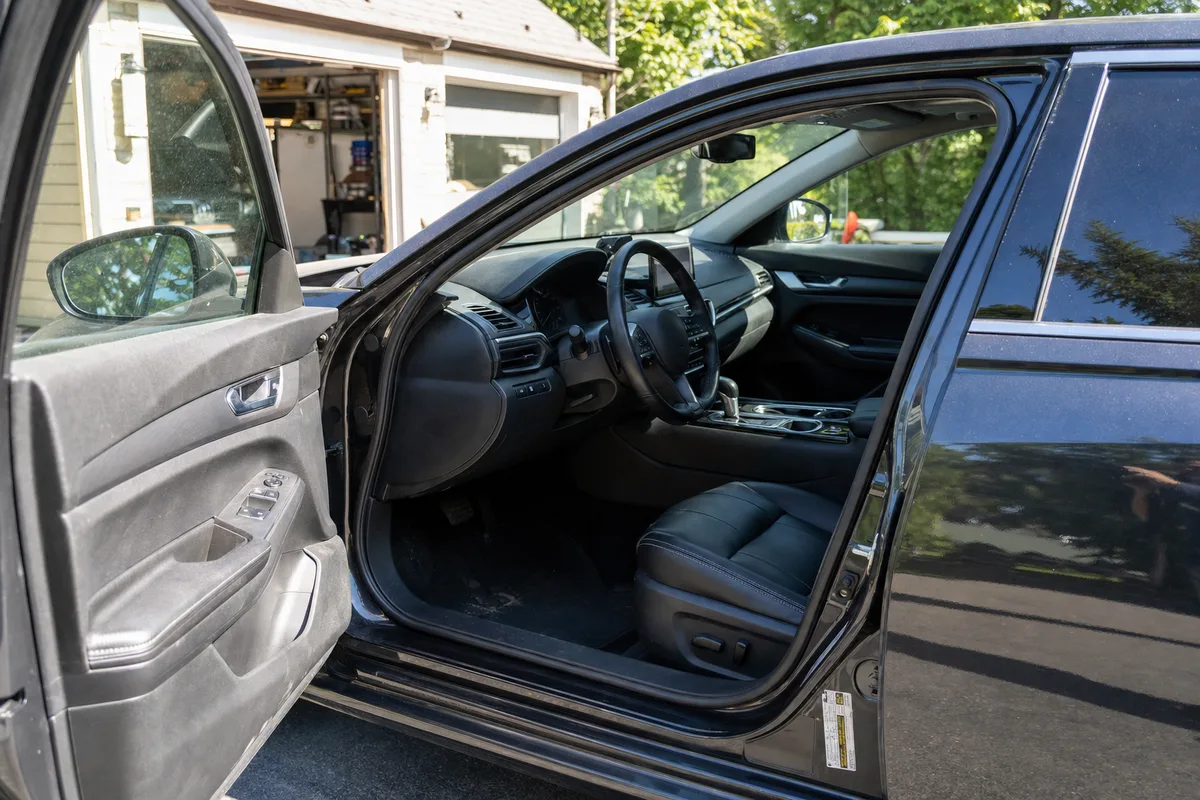
Open the driver's door and look at the white and yellow placard on the door jamb or the B-pillar. The same size is also molded into the sidewall of the tires currently on the car, unless someone changed them.
What size tires does a 2024 Porsche Cayenne take?
The 2024 Porsche Cayenne came from the factory on 285/45R21 and 285/45R20. Wheel packages can change that within the same model year, so check the placard inside the door jamb before you order.
What size tires does a 2023 Porsche Cayenne take?
The 2023 Porsche Cayenne came from the factory on 285/45R21 and 285/45R20. Wheel packages can change that within the same model year, so check the placard inside the door jamb before you order.
What size tires does a 2022 Porsche Cayenne take?
The 2022 Porsche Cayenne came from the factory on 285/45R21 and 285/45R20. Wheel packages can change that within the same model year, so check the placard inside the door jamb before you order.